Flesch-Kincaid Grade Level Meaning: How to Interpret Your Score
Learn what a Flesch-Kincaid Grade Level score means, how to interpret scores like 6.8 or 12.4, and what to do when your writing scores too high.
🔍 Over 12,558+ texts analyzed
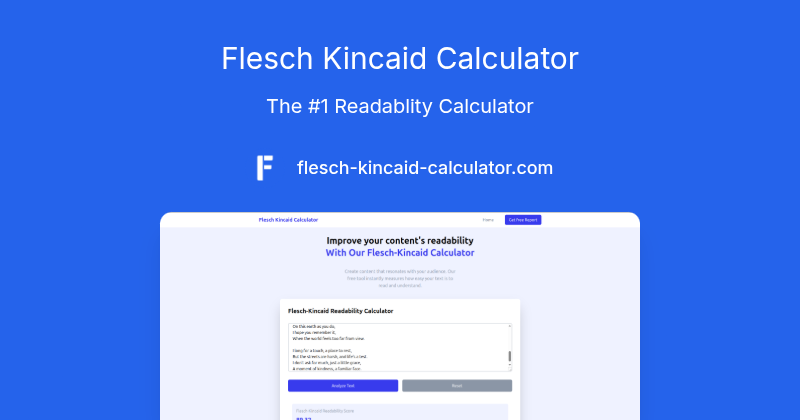
Paste your text into this free Flesch-Kincaid calculator to instantly check your FK score, Flesch Reading Ease, Flesch-Kincaid Grade Level, sentence counts, syllables, and practical readability targets. Use it as a Flesch score calculator, Flesch Reading Ease calculator, Flesch-Kincaid grade level calculator, or all-in-one readability checker. No signup required.
0
0
0
0
0
0
This homepage is the all-in-one Flesch-Kincaid calculator. If you specifically searched for a Flesch Reading Ease calculator, use the dedicated page for the classic 0–100 reading ease score, score meaning, formula notes, and example targets.
Our Flesch-Kincaid Calculator is the perfect tool for anyone who wants to improve the readability of their text. It's easy to use and provides accurate results.
Make your content more accessible to a wider audience by optimizing its reading level.
Search engines favor content that's easy to read. Improve your rankings with optimized text.
Get comprehensive metrics including sentence length, syllable count, and grade-level equivalents.
Our tool uses proven formulas to measure and improve your content's readability
Simply paste your content into the text area. Our tool can analyze everything from short paragraphs to full articles.
Our algorithm calculates key metrics including sentence complexity, word length, and overall reading ease.
Get specific recommendations to improve your content's readability for your target audience.
Get started with our free Flesch-Kincaid Calculator today and see immediate improvements in your content's performance.
Analyze content for free!This page is your main Flesch Kincaid calculator and Flesch reading score calculator. Paste text and get an instant readability score, Flesch Reading Ease score, and Flesch-Kincaid Grade Level with no signup. The tool helps you check whether your writing is easy enough for your intended audience, then revise and retest quickly.
The calculator returns both Flesch-Kincaid outputs from one text sample: a 0-100 Flesch Reading Ease score and a Flesch-Kincaid grade level. Paste your draft, run the check, then use the score table and revision guidance to make the text easier to read.
Check my FK scoreFlesch-Kincaid is widely used by content teams, educators, agencies, and public-sector writers because it gives a practical readability target you can act on. If your goal is clearer writing for broad audiences, this Flesch score calculator is the core workflow.
The calculator reports both common Flesch-Kincaid outputs: Flesch Reading Ease, a 0-100 score where higher usually means easier to read, and Flesch-Kincaid Grade Level, an estimated U.S. school grade level. Seeing both helps you compare a simple score with a more concrete reading-level target.
Searchers use different names for the same workflow: Flesch score calculator, FK score calculator, Flesch Reading Ease calculator, and Flesch-Kincaid grade level calculator. This homepage is the canonical all-in-one tool for those intents because it calculates the 0-100 ease score and the U.S. grade-level estimate from the same pasted text.
FK is simply shorthand for Flesch-Kincaid. If you need an FK score, use the calculator above to get both the Flesch Reading Ease score and the Flesch-Kincaid Grade Level result in one report.
If you searched for an FK score calculator, use this same tool. FK score is a shorthand for Flesch-Kincaid or Flesch score checks, and the calculator above reports the Reading Ease score, grade level, word count, sentence count, and syllable data together.
If you only need one dedicated metric, the related pages below explain Reading Ease and Grade Level separately. If you want the fastest answer, paste your draft above and use both scores together before revising.
Start with a representative sample (usually 100+ words). Run the analysis, then improve clarity by shortening long sentences, reducing jargon, and replacing complex wording where possible. Re-run after each draft to track progress and keep your text aligned with your target reading level.
Flesch Reading Ease and Flesch-Kincaid Grade Level both use sentence length and syllables per word. Shorter sentences and simpler words usually increase Reading Ease and lower Grade Level. The calculator reports the formulas side by side so you can see whether edits make the same text easier for readers.
For general web audiences, many teams aim around 6th-8th grade readability. Technical or specialist writing may reasonably be higher. What matters is matching content complexity to the reader expectation for that page.
| Use case | Common target | What it means |
|---|---|---|
| Public web pages | Grade 6-8 | Clear enough for broad audiences and quick scanning. |
| Marketing and help content | Grade 7-9 | Usually accessible while still allowing product-specific terms. |
| Academic or technical content | Grade 10+ | Acceptable when readers expect specialist vocabulary. |
Need the exact 0-100 reading ease score? Use the dedicated Flesch Reading Ease Calculator. Need only the U.S. school grade output? Use the dedicated Flesch-Kincaid Grade Level Calculator. To compare all formulas at once, use the Combined Readability Score Checker or browse the Readability Calculators hub.
The Flesch-Kincaid readability score (also called Flesch Reading Ease) is a formula that measures how easy a piece of text is to read. It produces a score from 0 to 100, where higher scores mean easier reading. The formula considers average sentence length and average syllables per word to estimate the reading difficulty.
The Flesch-Kincaid grade level converts the readability score into the U.S. school grade level needed to understand the text. For example, a grade level of 8 means the text is suitable for an 8th grader. It uses the same factors as the reading ease score—sentence length and syllable count—but outputs a grade level instead of a 0–100 score.
For general audiences, aim for a Flesch Reading Ease score of 60–70 (8th–9th grade level) or higher. For consumer content and marketing, 70–80 (7th grade) is often recommended. Technical or academic writing may appropriately score lower. Many organizations target 6th–8th grade for maximum accessibility.
To improve readability: use shorter sentences, choose simpler words with fewer syllables, break up long paragraphs, and avoid jargon. Replace complex words with common alternatives where possible. Our calculator helps you measure your current score so you can track improvements as you revise.
Flesch Reading Ease gives a score from 0–100 (higher = easier). Flesch-Kincaid Grade Level gives a U.S. school grade (e.g., 8th grade). Both use the same inputs—sentence length and syllables per word—but present the result differently. Grade level is often preferred when you need to match content to a specific audience education level.
It is both. The main calculator works as a Flesch Reading Ease calculator and a Flesch-Kincaid grade level calculator from the same pasted text, so you can evaluate readability as a 0–100 score and as a practical U.S. school grade level.
Yes. FK is a common shorthand for Flesch-Kincaid. This FK score calculator checks the main Flesch-Kincaid outputs from one pasted text sample: Flesch Reading Ease, Flesch-Kincaid Grade Level, sentence counts, word counts, and syllable details.
Yes. Paste your text into the calculator and run the analysis to check Flesch-Kincaid grade level online for free. The result includes the grade level, Flesch Reading Ease score, sentence count, word count, syllable details, and revision guidance with no signup required.
Use this homepage when you want the all-in-one Flesch-Kincaid calculator. It calculates Flesch Reading Ease, Flesch-Kincaid Grade Level, sentence counts, syllables, and related readability details together. The dedicated Reading Ease and Grade Level pages are best when you want a focused explanation of one metric.
Discover tips, guides, and insights about readability and writing
Learn what a Flesch-Kincaid Grade Level score means, how to interpret scores like 6.8 or 12.4, and what to do when your writing scores too high.
Compare SMOG vs Flesch-Kincaid for healthcare, patient education, and public-facing writing so you can choose the right readability formula with confidence.
Learn the SMOG readability formula, what polysyllable counts mean, how to interpret SMOG grade levels, and when to use SMOG instead of Flesch-Kincaid.