🔍 Over 2,636+ texts analyzed

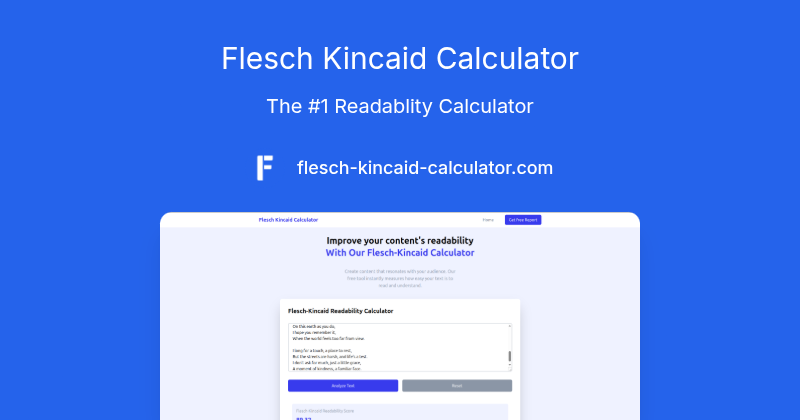
Improve your content's readability

With Our Flesch-Kincaid Calculator

Create content that resonates with your audience. Our free tool instantly measures how easy your text is to read and understand.

Get all 9 formulas at once: Combined Readability Checker

Flesch-Kincaid Readability Score

0

Flesch-Kincaid Grade Level

0

Average sentence length

0

Total words

0

Total sentences

0

Total Syllables

0

Why Choose Our Flesch-Kincaid Calculator?

Our Flesch-Kincaid Calculator is the perfect tool for anyone who wants to improve the readability of their text. It's easy to use and provides accurate results.

Improved Readability

Make your content more accessible to a wider audience by optimizing its reading level.

Boost SEO Rankings

Search engines favor content that's easy to read. Improve your rankings with optimized text.

Detailed Analysis

Get comprehensive metrics including sentence length, syllable count, and grade-level equivalents.

How the Flesch-Kincaid Calculator Works

Our tool uses proven formulas to measure and improve your content's readability

1

Input Your Text

Simply paste your content into the text area. Our tool can analyze everything from short paragraphs to full articles.

2

Instant Analysis

Our algorithm calculates key metrics including sentence complexity, word length, and overall reading ease.

3

Actionable Insights

Get specific recommendations to improve your content's readability for your target audience.

Ready to Improve Your Content?

Get started with our free Flesch-Kincaid Calculator today and see immediate improvements in your content's performance.

Analyze content for free!

What Is the Flesch-Kincaid Calculator?

The Flesch-Kincaid calculator on this page gives you two readability measures at once: the Flesch Reading Ease score (0–100) and the Flesch-Kincaid grade level (U.S. school grade). Both use the same formula—average sentence length and average syllables per word—so you can see how easy your text is to read and what grade level it matches. Paste your text above, click analyze, and get instant results with no signup.

Rudolf Flesch developed the Reading Ease formula in 1948; the U.S. Navy (J. Peter Kincaid and colleagues) adapted it into a grade level in 1975. Today it is one of the most widely used readability metrics in education, government, and business. Writers, editors, and content teams use it to match content to their audience and to meet plain-language guidelines.

Who Uses This Calculator?

Educators use it to check that handouts and assignments match student reading ability. Marketers and web writers use it to keep copy accessible (often aiming for 8th grade or lower). Healthcare and government communicators use it to hit targets like 6th–8th grade for patient or public materials. Students use it to check that essays and reports are at the right level. Anyone who cares about clear writing can paste text here and see where they stand.

Reading Ease vs Grade Level

The Flesch Reading Ease score runs from 0 (very difficult) to 100 (very easy). The Flesch-Kincaid grade level is the same formula expressed as a U.S. grade—e.g. 7th grade or 10th grade. This calculator shows both so you can use whichever your guideline or audience prefers. For a 0–100–only view, try our Flesch Reading Ease Calculator; for a grade-level–focused page, see the Flesch-Kincaid Grade Level Calculator.

Common Targets and How to Improve

For general audiences, a Reading Ease score of 60–70 or a grade level of 8th or below is often recommended. To improve: shorten sentences, use words with fewer syllables where possible, and replace jargon with everyday words. One main idea per sentence helps. Run your text through the calculator above, revise, and check again to see how your score or grade changes.

More Readability Tools

Need all nine formulas in one place? Use our Combined Readability Score Checker to get Flesch-Kincaid, SMOG, Gunning Fog, Dale-Chall, ARI, Coleman-Liau, Linsear Write, Lix, and Rix side by side. For individual calculators (SMOG, Gunning Fog, and more), see the Readability Calculators hub.

Frequently Asked Questions

What is the Flesch-Kincaid readability score?

The Flesch-Kincaid readability score (also called Flesch Reading Ease) is a formula that measures how easy a piece of text is to read. It produces a score from 0 to 100, where higher scores mean easier reading. The formula considers average sentence length and average syllables per word to estimate the reading difficulty.

What is the Flesch-Kincaid grade level?

The Flesch-Kincaid grade level converts the readability score into the U.S. school grade level needed to understand the text. For example, a grade level of 8 means the text is suitable for an 8th grader. It uses the same factors as the reading ease score—sentence length and syllable count—but outputs a grade level instead of a 0–100 score.

What is a good Flesch-Kincaid score?

For general audiences, aim for a Flesch Reading Ease score of 60–70 (8th–9th grade level) or higher. For consumer content and marketing, 70–80 (7th grade) is often recommended. Technical or academic writing may appropriately score lower. Many organizations target 6th–8th grade for maximum accessibility.

How can I improve my Flesch-Kincaid score?

To improve readability: use shorter sentences, choose simpler words with fewer syllables, break up long paragraphs, and avoid jargon. Replace complex words with common alternatives where possible. Our calculator helps you measure your current score so you can track improvements as you revise.

What is the difference between Flesch Reading Ease and Flesch-Kincaid Grade Level?

Flesch Reading Ease gives a score from 0–100 (higher = easier). Flesch-Kincaid Grade Level gives a U.S. school grade (e.g., 8th grade). Both use the same inputs—sentence length and syllables per word—but present the result differently. Grade level is often preferred when you need to match content to a specific audience education level.

Latest from Our Blog

Discover tips, guides, and insights about readability and writing