
The Flesch-Kincaid formulas look more complicated than they really are. Both formulas are trying to answer the same practical question: how much effort will this text take to read?
They do that by looking at two simple signals:
- average sentence length
- average syllables per word
Longer sentences usually raise difficulty. Longer words usually raise difficulty. The formulas turn those two signals into either a 0-100 Reading Ease score or a U.S. school grade level.
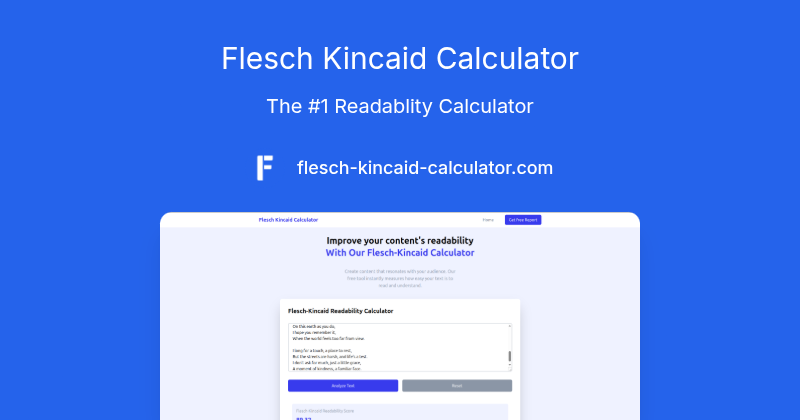
If you want the result without doing the math, paste your draft into the Flesch-Kincaid calculator. This guide explains what the calculator is doing and how to interpret the numbers without treating them like a writing contest.
#The two Flesch-Kincaid formulas
People often say “the Flesch-Kincaid formula” as if there is only one. In practice, there are two related formulas.
#Flesch Reading Ease formula
1206.835 - 1.015 × (total words ÷ total sentences) - 84.6 × (total syllables ÷ total words)
This produces a score that usually sits between 0 and 100, although unusual text can go below 0 or above 100.
Higher is easier:
| Reading Ease score | Rough interpretation |
|---|---|
| 90-100 | Very easy |
| 80-89 | Easy |
| 70-79 | Fairly easy |
| 60-69 | Plain English for many adult readers |
| 50-59 | Fairly difficult |
| 30-49 | Difficult |
| 0-29 | Very difficult |
Use the Flesch Reading Ease calculator when you want this 0-100 view.
#Flesch-Kincaid Grade Level formula
10.39 × (total words ÷ total sentences) + 11.8 × (total syllables ÷ total words) - 15.59
This produces an estimated U.S. school grade level. A score of 8.0 roughly means eighth-grade reading difficulty. A score of 12.0 roughly means high-school senior difficulty.
Use the Flesch-Kincaid Grade Level calculator when you need a grade-level target.
#What each part of the formula means
Both formulas use the same ingredients.
#Words per sentence
This is also called average sentence length.
1total words ÷ total sentences
If a 200-word passage has 10 sentences, the average sentence length is 20 words.
That does not mean every sentence must be short. It means a draft full of long sentences will usually feel harder to process, especially online. A long sentence can be fine when it is well structured. Five long sentences in a row usually are not.
#Syllables per word
This is the average word length measured by sound, not letters.
1total syllables ÷ total words
Words like “use,” “clear,” and “help” are one syllable. Words like “instruction,” “authorization,” and “implementation” have more syllables, so they push the score toward harder reading.
The formula is not saying long words are bad. Sometimes the longer word is the right word. It is saying that too many long words, especially inside long sentences, create more reading effort.
#Worked example: an easy sentence
Take this sentence:
Clear steps help people finish the task without extra confusion.
For a simple worked example, count it as:
- 10 words
- 1 sentence
- 12 syllables
That gives:
 1words per sentence = 10 ÷ 1 = 10
 2syllables per word = 12 ÷ 10 = 1.2
Flesch Reading Ease:
1206.835 - 1.015 × 10 - 84.6 × 1.2 = 95.2
Flesch-Kincaid Grade Level:
10.39 × 10 + 11.8 × 1.2 - 15.59 = 2.5
That is very easy reading. For a short instruction, that may be exactly what you want. For a technical report, it may be too simple to carry enough detail.
#Worked example: a denser sample
Now imagine a dense paragraph with these averages:
- 180 words
- 10 sentences
- 330 syllables
That gives:
 1words per sentence = 180 ÷ 10 = 18
 2syllables per word = 330 ÷ 180 = 1.83
Flesch Reading Ease:
1206.835 - 1.015 × 18 - 84.6 × 1.83 = 33.5
Flesch-Kincaid Grade Level:
10.39 × 18 + 11.8 × 1.83 - 15.59 = 13.1
That is much harder. A sample like this often contains abstract wording such as “comprehensive,” “organizational,” “stakeholders,” “implementation,” “requirements,” or “operational.” The issue is not that any one word is forbidden. The issue is the combined reading load.
A sentence like this may be technically correct:
Comprehensive documentation enables organizational stakeholders to evaluate implementation requirements before approving operational changes.
A clearer version might be:
Clear documentation helps teams understand what must change before they approve the work.
That version does not remove the idea. It removes some of the friction.
#Why the formulas can disagree with your judgment
Flesch-Kincaid is useful, but it is not a full writing-quality test.
It does not know whether:
- the page answers the reader’s actual question
- the structure is logical
- examples are useful
- technical terms are necessary
- the tone fits the audience
- a short sentence is vague or precise
This matters because you can game the score and still write a weak page. “Do it. It works. Use it now.” is easy to read, but it may not be useful. A medical discharge instruction may need a few longer terms because precision matters.
Use the formula as a diagnostic, not a judge.
#How to use the formula while editing
The formula points to two editing levers.
#1. Shorten overloaded sentences
If your grade level is too high, scan for sentences with multiple clauses, stacked commas, or several ideas joined together.
Instead of:
The policy should be reviewed by every department before publication because each team may identify compliance risks, customer impact, or operational issues that the original writer missed.
Try:
Every department should review the policy before publication. Each team may spot compliance risks, customer impact, or operational issues the writer missed.
You kept the meaning. You reduced the reading burden.
#2. Replace unnecessary long words
Do not replace every long word. Replace long words that are only there out of habit.
| Heavier wording | Clearer wording |
|---|---|
| utilize | use |
| facilitate | help |
| prior to | before |
| due to the fact that | because |
| in order to | to |
Small changes like these often improve the score without making the writing feel childish.
#3. Keep necessary terms and explain them
Some long words are unavoidable. If you are writing about “photosynthesis,” “authentication,” or “medication,” the clear move is usually to explain the term, not hide it.
A good pattern is:
Authentication means checking that a person is really allowed to access an account.
The technical word stays. The next sentence reduces friction.
#4. Re-test the whole passage, not one sentence
Readability formulas are more stable on longer samples. A single sentence can swing wildly. A 300-word section gives a more useful signal.
For the best workflow, test the page, revise the hardest sections, then test again with the main readability calculator.
#When each Flesch-Kincaid score is most useful
Use Reading Ease when you want a fast accessibility signal. It is helpful for web copy, blog posts, emails, help docs, and public-facing explanations because the 0-100 scale is easy to compare across drafts.
Use Grade Level when you need a concrete audience target. It is helpful for education, policy, healthcare, training material, and any content where a team has agreed on a grade-level range.
If you want both scores plus other formulas, use the readability score checker. Comparing formulas can show whether only Flesch-Kincaid is flagging a problem or whether several methods agree.
#Common mistakes with the Flesch-Kincaid formula
#Treating one score as a universal target
There is no perfect score for every text. A homepage, a grant proposal, a patient handout, and a developer guide should not all aim for the same number.
#Lowering the grade level by deleting useful detail
A lower grade level is not automatically better. If the edit removes examples, context, or important warnings, the page may become easier and less useful at the same time.
#Ignoring headings and layout
The formula mostly sees sentences and syllables. Readers also care about headings, spacing, lists, examples, and the order of ideas. A readable page is more than a readable sentence.
#Checking too little text
Short samples can mislead you. Check a complete section or full page before making major decisions.
#FAQ
#What is the Flesch-Kincaid formula?
There are two common formulas. Flesch Reading Ease is 206.835 - 1.015 × words per sentence - 84.6 × syllables per word. Flesch-Kincaid Grade Level is 0.39 × words per sentence + 11.8 × syllables per word - 15.59.
#Is a higher Flesch-Kincaid score better?
For Flesch Reading Ease, higher usually means easier to read. For Flesch-Kincaid Grade Level, higher means harder because it estimates a higher school grade level.
#What is a good Flesch Reading Ease score?
For general web writing, many teams like the 60-70 range or higher. But the right target depends on the audience and topic. Technical or specialist content may naturally score lower.
#What is a good Flesch-Kincaid Grade Level?
For broad public content, many teams aim around grades 6-8. Specialist content may be higher. The best target is the lowest level that still keeps the meaning accurate.
#Can I calculate Flesch-Kincaid manually?
Yes. Count words, sentences, and syllables, then plug the averages into the formula. Manual syllable counting is slow and easy to get wrong, so most people use a calculator for real drafts.
#Related calculators
- Use the Flesch-Kincaid calculator for the main workflow and both core scores.
- Use the Flesch Reading Ease calculator for the 0-100 score.
- Use the Flesch-Kincaid Grade Level calculator for grade-level targets.
- Use the readability score checker to compare multiple readability formulas.