
A Flesch-Kincaid Grade Level score estimates the U.S. school grade needed to understand a piece of writing. A score of 8.0 means the text is roughly eighth-grade level. A score of 12.0 means it is closer to the level expected near the end of high school.
That does not mean only eighth graders can read an 8.0 score. It means the sentence length and word length look similar to text written for that grade range. Adults often prefer lower-grade writing because it is faster to scan and easier to act on.
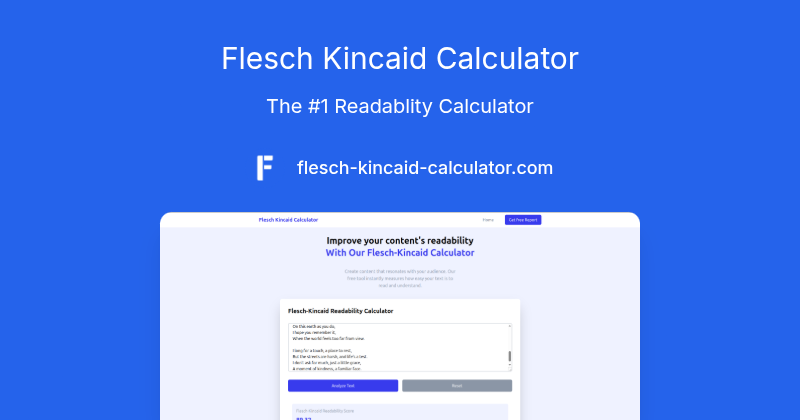
If you already have a draft, paste it into the free Flesch-Kincaid calculator to get both Grade Level and Reading Ease. If you only need the grade-level result, use the dedicated Flesch-Kincaid Grade Level calculator. This guide explains what the grade-level number means after you see it.
#The short answer
Flesch-Kincaid Grade Level turns readability into a school-grade estimate:
| Score range | Practical meaning | Common fit |
|---|---|---|
| 5-6 | Very accessible | Simple instructions, broad public copy |
| 7-8 | Clear for many adults | Web pages, help docs, marketing pages |
| 9-10 | More detailed | Business writing, reports, explainers |
| 11-12 | Advanced high school | Policy, technical, or academic-leaning text |
| 13+ | College level or above | Specialist, legal, academic, or dense professional writing |
Lower is usually easier. Higher is not automatically bad. The right score depends on the reader, the topic, and what the reader needs to do next.
#How to read a decimal score
Many tools show Grade Level with a decimal, such as 6.8, 9.4, or 12.7.
A decimal score is not meant to be a precise classroom placement. Treat it as a readability estimate:
- 6.8 is roughly late sixth grade to early seventh grade.
- 8.2 is roughly eighth-grade level.
- 10.5 is around the middle of tenth grade.
- 13.1 suggests college-level difficulty.
For editing, it is usually better to think in bands than exact decimals. A draft at 8.1 and a draft at 8.4 are not meaningfully different. A draft at 8.1 and a draft at 13.4 probably are.
#What the score actually measures
Flesch-Kincaid Grade Level uses two surface-level signals:
- Average sentence length: longer sentences usually raise the grade level.
- Average syllables per word: longer, syllable-heavy words usually raise the grade level.
That is why a sentence like this can score high:
The implementation of comprehensive documentation procedures substantially improves organizational compliance outcomes.
A clearer version will usually score lower:
Clear documentation helps teams follow compliance rules.
The second sentence is shorter and uses simpler words. It is also easier to understand.
#What is a good Flesch-Kincaid Grade Level?
A good score is the one that fits the audience.
For broad public writing, many teams aim for grade 6-8. That range often works well for website copy, help pages, emails, and public information because it supports quick reading.
For business or specialist content, grade 9-12 may be fine if the reader expects the topic and knows the vocabulary. Technical documentation, legal text, academic writing, and policy material often score higher for valid reasons.
Use the score as a clarity check, not a rule. If a required term is accurate and familiar to the audience, keep it. If a long word is just inflated wording, replace it.
#Examples by content type
| Content type | Sensible starting target | Why |
|---|---|---|
| Public service information | Grade 6-8 | Readers may be stressed, distracted, or in a hurry. |
| Product landing page | Grade 7-9 | Visitors need to understand value quickly. |
| Help center article | Grade 6-8 | Clear steps matter more than impressive wording. |
| B2B blog post | Grade 8-10 | Some industry terms may be necessary. |
| Technical documentation | Grade 9-12+ | Accuracy and expected terminology can raise the score. |
| Academic or legal text | Grade 12+ | Dense concepts and formal wording may be appropriate. |
If you need more benchmarks, see what makes a good readability score.
#Why a high score happens
A Flesch-Kincaid Grade Level often rises for predictable reasons:
- sentences are too long
- paragraphs stack several ideas at once
- abstract nouns replace direct verbs
- jargon appears before it is explained
- the writing uses formal filler such as “utilize,” “facilitate,” or “in order to”
- necessary technical terms appear often
The last point matters. Sometimes a higher score is not a problem. A medical, engineering, or legal document may need precise terms. The goal is not to force every page into grade 6. The goal is to remove difficulty that does not help the reader.
#How to lower the grade level without dumbing it down
Start with structure before rewriting every word.
- Split overloaded sentences. If one sentence contains two or three points, break it up.
- Put the main point first. Readers should not wait until the end to understand the sentence.
- Use shorter everyday words when meaning stays the same. “Use” is usually better than “utilize.”
- Define necessary terms once. Keep the right technical word, but explain it in plain language.
- Turn dense paragraphs into lists. Lists reduce the burden on memory and make steps easier to scan.
- Retest after editing. A score only helps when you compare before and after versions.
For a deeper editing process, read how to improve readability without dumbing it down.
#Grade Level vs Reading Ease
Flesch-Kincaid Grade Level and Flesch Reading Ease use similar inputs, but they report the result differently.
- Grade Level estimates a U.S. school grade. Lower is easier.
- Reading Ease uses a 0-100 scale. Higher is easier.
If your team talks about targets like “write at an eighth-grade level,” Grade Level is easier to explain. If you want a quick ease signal, Reading Ease can be more intuitive.
The two numbers usually move together: when you shorten sentences and use clearer words, Grade Level usually goes down and Reading Ease usually goes up. To test the 0-100 side of the pair, use the Flesch Reading Ease calculator. For a side-by-side comparison, see Flesch Reading Ease vs. Flesch-Kincaid Grade Level.
#Common mistakes when interpreting the score
Avoid these traps:
- Treating the decimal as exact. A 7.8 is not magically better than an 8.1.
- Assuming lower is always better. A very low score can feel choppy if the topic needs nuance.
- Removing necessary terminology. If readers expect the term, define it instead of deleting it.
- Ignoring organization. A page can score well and still confuse readers if the ideas are in the wrong order.
- Using one score for every audience. A public benefits page and a specialist API guide should not have the same target.
#Bottom line
Flesch-Kincaid Grade Level is a useful editing signal. It tells you whether the text looks easy or difficult based on sentence length and word length. It does not judge accuracy, usefulness, tone, or audience knowledge.
Use the number to ask better questions: Is this score right for the reader? Are long sentences making the page harder than it needs to be? Are complex words necessary, or just habit?
When you want to check a draft, use the Flesch-Kincaid calculator and compare the score before and after editing. The best result is not the lowest possible number. It is the clearest version that still respects the reader and the topic.